Annotated bibliography of works and studies on Libya in the Russian National Library
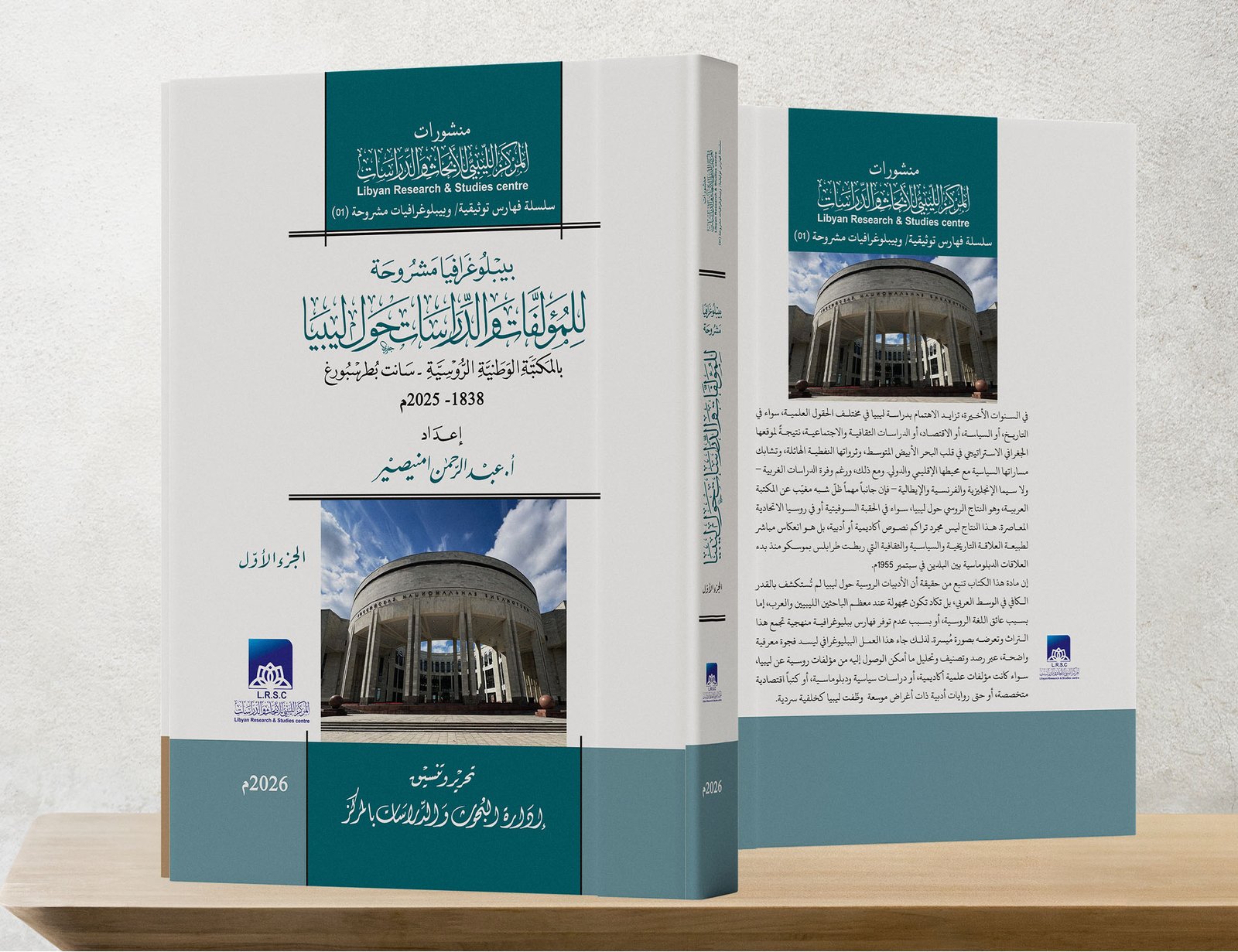
An annotated bibliography of works and studies on Libya in the National Library of Russia – St. Petersburg
Prepared by researcher Abdulrahman Amnesir, edited and formatted by the Research and Studies Department at the Center. The book comprises 312 pages of medium format, including appendices.
This is the first part of a major scientific project the center is currently undertaking: documenting what has been written about Libya in the world’s largest libraries and archives. We commissioned a Libyan researcher to conduct a comprehensive survey of what has been written about Libya in the Russian National Library in St. Petersburg, one of the world’s largest libraries, containing more than 40 million titles. In truth, when we embarked on this task, we did not anticipate such a wealth of references on Libya. These references are diverse, encompassing books, reports, doctoral dissertations, memoirs of ambassadors, diplomats, and travelers, reports of scientific missions, and more, spanning a long period from 1838—the date of publication of the oldest book on Libya included in this volume—to 2025. This diversity undoubtedly reflects the extent of Russian interest in Libya’s importance to Russian scholars during the Tsarist, Soviet, and Russian eras. It also highlights the depth of Russian Orientalist studies on Libya, a field largely unfamiliar to most Libyan scholars in particular, and Arab scholars in general, due to the scarcity of researchers. Those who are proficient in Russian, and for other reasons.
This first part contains annotated bibliographies of eighty-eight books. The number of pages dedicated to each book varies according to its importance, content, and reliability. Undoubtedly, by publishing this book, we have rendered a valuable service to the Libyan library, which lacks this type of annotated bibliography, particularly in Russian. Researchers interested in Libyan affairs will find in it a unique resource, providing them with titles of books, reports, and memoirs by Russian and Western authors, scholars, and historians, some of whom they may be encountering for the first time. This opens new doors that were previously closed due to the language barrier and the scarcity of detailed bibliographies about Libya.